Yes, it's true...I have reached book 30 for the year. Huzzah! In fact, it happened at the end of August which should tell you something about my blogging efforts (though I've been getting better - have you noticed?).
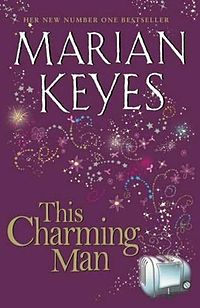
I picked up This Charming Man, by Marian Keyes, when I was in Italy. Even though this particular edition was enormous, I still couldn't resist - her books are generally light and fluffy but loveable. I have been carrying around a soft spot for Angels for years. This Charming Man centers around popular Irish politican Paddy de Courcy and the four women who have been most affected by him. The novel starts with Lola, completely crushed as she learns that Paddy is getting married - because she's his girlfriend but not the fiancee. It then turns to Grace, a journalist, and Marnie, her alcoholic sister, who knew Paddy as teenagers. Lastly is Alicia, Paddy's surprise fiancee, who has an odd role as a wallflower (and as it turns out later, a backstabber). Each woman has her own section in the book as we see their life and Paddy's effect, either past or present on that, until they come together as a group near the end.
This book was a little darker than the other Keyes' books I've read. To the world, Paddy is a JFK-like figure but it turns out that he's conniving, selfish and abusive, and has done some serious psychic damage to these ladies. There's a really delicate balance that has to be made between chick-lit lightness and topical seriousness but overall, I thought she did it well, and I ended up giving the book to my mom to read.
Showing posts with label Chick Lit. Show all posts
Thursday, November 03, 2011
Thursday, August 04, 2011
Not-So-Sweet Valley Confidential (#10)
I LOVED the Sweet Valley High books when I was a kid, mostly because they were about perfect California teenagers doing perfect California things. When I was 12, nothing seemed more exciting than that. So I was pretty darn thrilled when I heard Francine Pascal, the series' creator, was releasing a follow-up last March (um, yes, we are discussing a book I read four months ago). Doesn't everyone want to know how 25-year old Elizabeth, Jessica, and the gang turned out?!?
It turns out that life is not so perfect anymore (until they all kiss and make up at the end, anyway). Elizabeth turns out to be a reporter, no surprise after her high-school days as the superstar columnist at The Oracle, but she's devastated when she finds out that her sister and her formerly puppy-dog loyal boyfriend, Todd Wilkins, have been having an affair. They're, like, so in love. And Jessica, like, feels so bad about it...and yet also feels like her twin should understand. The rest of the book is basically backstory and apologizing while Elizabeth licks her wounds.
The sad truth is, no one should have let Francine Pascal near a Word document. After reading the drivel that is Sweet Valley Confidential, I now understand, very clearly, why ghostwriters wrote the entire SVH series. Because this book is outrageously terrible. I would have excused it and said that, like the series, it was written for pre-teens who don't know any better (like, ahem, Twilight) but I realized that's not even true - this book IS written for adults, the adults who nostalgically remember the 80s and the books they loved.
Numerous reviewers on Amazon have pointed out the factual inconsistencies between Sweet Valley Confidential and the series though I admittedly don't remember the books that well. For me, the worst part of this book was the very thin plot filled with inane dialogue and the most extreme of events that somehow took 300 pages to tell. Nothing normal happens in this book - everything is to extremes and, like, the worst thing EVER. Several characters have complete personality changes: The resident asshole's parents die and he turns into an angel; the sweet, bumbling nerd turns into an asshole and dies falling off a balcony; the protective older brother appears to be an serial adulterer until it turns out, omg, he's gay! It's laughably the worst.
Actually, I take that back. You want to know the worst part? This book was enough of a bestseller that St. Martin's has given the green light to a new series based on their adult lives, to reportedly be released starting next spring. According to the New York Times, it will be published online in installments and have the cliffhanger feel of the original series. To quote the NYT quoting St. Martin's publisher Dan Weiss, "It's really e-mass market." Let's just hope they decide to hire a new writer.
Monday, October 25, 2010
#16: Good in Bed, Jennifer Weiner
Before heading off to Europe this summer, I visited Half-Price Books to pick up some beach reads (ha, not that I spent much time on the beach). I had long heard about Good in Bed - mostly that it represented the best of chick-lit - and thought it might provide some easy entertainment as I made my way through half-lit hostels. Ugh - how wrong I was. I hated this book; in fact, I think it represents all that is wrong with the genre, a genre which I now pledge to stop reading (really, I promise).Ostensibly, Good in Bed is about the protagonist's body issues. Cannie is a 28-year-old newspaper reporter who essentially loses her shit when her newly ex-boyfriend writes a magazine column about her entitled "Loving a Larger Woman." Even though Bruce is kind of a loser/creep, she decides that she wants him back and spends the next hundred pages obsessing. But then, on page 164, a surprise arrives and then the rest of the book veers off into something else (which I won't spoil)...and to somewhere else, an imaginary place called Never Never Land where screenplays magically get sold in an afternoon. I know chick lit generally contains fantastical elements but Good in Bed really went overboard - and it was eye-rolling because the characters were one-dimensional and Cannie barely agonized over/worked for any of her big decisions or accomplishments. The moral of the story seemed to be *whine a lot, get a lot* and it really pissed me off.
Before I let this one go, though, I do have to point out an error that really cracked me up. On page 26, Weiner writes, in Cannie's voice, "I felt scalded by shame, like I was wearing a giant crimson C..." But following the reference to The Scarlet Letter, Cannie wouldn't wear a C, because the letter isn't meant to represent her first name. In Nathaniel Hawthorne's classic - which I was forced to read twice in high school - the letter is an A, to represent the sin of adultery, not adultress Hester Prynne's first name. Clearly I really was meant to be an English teacher.
Sunday, April 11, 2010
#5: Rude Awakenings of a Jane Austen Addict, Laurie Viera Rigler
I have mixed feelings on Rude Awakenings of a Jane Austen Addict. On the one hand, it's well-written and pleasant and I looked forward to getting back to it whenever I had a chance. On the other, nothing happened; the book never really moved past the set-up into a space where the narrator could act on what she'd learned. So it was good but I wish it had moved into the story it had spent nearly 300 pages developing.
But I'm getting ahead of myself. Rude Awakenings of a Jane Austen Addict is the story of Jane Mansfield, a young woman in Regency England who wakes up one morning after bumping her noggin to find herself in modern-day Los Angeles, where everyone thinks she is someone called Courtney Stone. (According to the Internet, Rigler's first novel, the equally lengthy titled Confessions of a Jane Austen Addict, deals with Courtney Stone's sudden arrival in Regency England, plopped down there in Jane Mansfield's life.) Jane is understandably confused and essentially spends the novel trying to figure out what has happened - and how to work all the newfangled devices that 21st-century L.A. provides. Jane soon learns that Courtney's life is a mess - Courtney-now-Jane hates her job, is swimming in debt, has just broken off an engagement with a suave but seedy guy, and fears that her best guy friend has betrayed her trust.
The book was funny and charming but I never felt like Jane learned anything of significance. All of the major actions she took were decisions of chance - because when she made the decisions, mostly at the very beginning of the book, she didn't know what she was doing or what it meant. She's ostensibly supposed to learn something about both herself and Courtney and then make better decisions for the both of them - or so says the magic fortune teller - but I frankly couldn't see what she had learned or how she applied it.
Saturday, May 23, 2009
#11 and #12: Something Borrowed and Something Blue, Emily Giffin
When I saw Something Borrowed and Something Blue on the "Buy 1, Get 1 Half Price" shelf at Borders a few weeks ago, I immediately snapped them up. I really enjoyed both of these books when I read them a few years ago. While they're firmly entrenched in the Chick Lit camp, Giffin skipped a lot of the standard cliches (as I recalled anyway).Something Borrowed was just as good as I remembered. I think I read it in less than 36 hours, despite already knowing how it would end. The story is about two childhood best friends, Rachel and Darcy, who are now adults and living in New York City. Darcy's always had a charmed life and when the novel starts, she's engaged to a handsome banker named Dex. Rachel, on the other hand, is more of a hardworking wallflower. But, on the night of Rachel's 30th birthday, she gets drunk and sleeps with Dex and drama ensues. (I'm not giving anything away, by the way - this is all on the back cover of the book.) As a reader, you certainly like Rachel from the start and root for her, but I thought Giffin did a good job of giving Darcy some appealing qualities, so that she's not a one-dimensional villain. Giffin also does a good job of revealing the story layer by layer - it's not quite what it seems to be on page one and while it's not over-the-top, I don't think you can really guess what's going to happen, either.
Something Blue, on the other hand, isn't quite as good and I think that's because it relies too much on its predecessor. The second book is Darcy's story and what happens to her after she loses Dex (sorry, it's a spoiler, but it's on the back of this book's cover!). As established in Book One, Darcy is a selfish, self-absorbed girl who occasionally stuck up for her best friend. Those qualities work in Something Borrowed because Darcy's supposed to lose. But then, in Book Two, when she's the heroine you're supposed to care about, it doesn't quite work. And it takes her 210 pages to figure out that she's the most shallow person ever. I think you keep reading through Darcy's selfishness because you want to know what happens to Rachel and Dex, but is that really enough for a book to stand on its own? In contrast to Something Borrowed, Something Blue also has much more of a conventional Chick Lit ending - meaning that everthing gets tied up into neat little bows. It's not terribly cheesy for the genre but still makes it a fluffier book than the first.
On a final note, I noticed a continuity error between Books One and Two. In Something Borrowed, Darcy's father's name is Hugo Rhone, as seen on the wedding invitations (page 242). However, in Book Two, he apparently changed his name to Hugh (page 112). Oops!
Next up: I've started reading Water for Elephants. I'm not terribly captivated at this point (this point being Chapter Three) but since people seem to love it, I'm still keeping on. However, I might start reading Revolutionary Road as I've only got it out of the library until June 3.
Sunday, June 08, 2008
#12: Love the One You're With, Emily Giffin
Usually my mother and I don't share the same taste in books, and she didn't like this one at all. She said, and I quote, "I don't understand how someone could be so obsessed." And while I disagree with that point, I thought Emily Giffin's 4th novel just lacked the character development that could make you believe someone could be so obsessed. I really liked her first two books, I thought Baby Proof was good but not great, and this one falls into the average Chick Lit category. I'm not sure now I will be so enthused to pick up her next book.
I almost always fold down pages that have some thought - a new vocabulary word, an idea - that I want to go back to and remember. Not this book, though. I only folded down pages that contained examples of things I wanted to point out here. This book just lacked substance; the characters were so cookie-cutter and one-dimensional.
Here's the basic set-up (with the spoiler, sorry): Our heroine Ellen dates Leo, a committment-phobic man, in NYC. She's devastated when he dumps her, and basically can't forget about him - even though she ends up marrying the rich, handsome, but boring brother of her best friend. She pretends like she's happy, and she is, at least passably. Until she runs into Leo on the street. He wants to revive their friendship, she starts fantasizing, she sees him in secret, and this time around, he treats her like a princess, telling her everything she ever wanted to hear. It eventually comes to a head: She has to choose between her husband and Leo. What does she do? She's about to do the dirty deed when her sister calls and tells her it's the wrong decision. So she leaves. And then spends the remaining 5 pages justifying why, in fact, she had never settled in the first place, despite the previous 200-odd pages to the contrary. So predictable, so boring!
Ugg. Seriously.
I almost always fold down pages that have some thought - a new vocabulary word, an idea - that I want to go back to and remember. Not this book, though. I only folded down pages that contained examples of things I wanted to point out here. This book just lacked substance; the characters were so cookie-cutter and one-dimensional.
Here's the basic set-up (with the spoiler, sorry): Our heroine Ellen dates Leo, a committment-phobic man, in NYC. She's devastated when he dumps her, and basically can't forget about him - even though she ends up marrying the rich, handsome, but boring brother of her best friend. She pretends like she's happy, and she is, at least passably. Until she runs into Leo on the street. He wants to revive their friendship, she starts fantasizing, she sees him in secret, and this time around, he treats her like a princess, telling her everything she ever wanted to hear. It eventually comes to a head: She has to choose between her husband and Leo. What does she do? She's about to do the dirty deed when her sister calls and tells her it's the wrong decision. So she leaves. And then spends the remaining 5 pages justifying why, in fact, she had never settled in the first place, despite the previous 200-odd pages to the contrary. So predictable, so boring!
Ugg. Seriously.
Tuesday, March 18, 2008
#4: Dedication, Emma McLaughlin and Nicola Kraus
Congratulations to Ms. McLaughlin and Ms. Kraus: Your book might actually be the worst one I'll read all year! I hope you've saved your pennies, ladies, as I imagine once your book contract runs out, you'll never be offered another one again.
I suppose it's my own fault. I read The Nanny Diaries. Yes, it was a bestseller, but it's the subject that sold it, not the writing. I didn't bother to read the second book, Citizen Girl, as it was universally panned. But I hadn't heard anything about Dedication and since I found the premise interesting (the protagonist's ex-boyfriend becomes a major rock star based on songs that are all about her personal business), I thought I'd give it a try. I should have saved myself instead. It's just stupid and entirely predictable. Blech!
Next up: Dan Brown's Deception Point
I suppose it's my own fault. I read The Nanny Diaries. Yes, it was a bestseller, but it's the subject that sold it, not the writing. I didn't bother to read the second book, Citizen Girl, as it was universally panned. But I hadn't heard anything about Dedication and since I found the premise interesting (the protagonist's ex-boyfriend becomes a major rock star based on songs that are all about her personal business), I thought I'd give it a try. I should have saved myself instead. It's just stupid and entirely predictable. Blech!
Next up: Dan Brown's Deception Point
#2: Baby Proof, Emily Giffin
I really adore Emily Giffin's books. Yes, they're Chick Lit but they're smartly written, have heroines you root for from the very beginning, and avoid the lame endings. I'd read all three of her books previously, and when I saw Baby Proof on the "buy one, get one 50 percent off" shelf at Borders, I grabbed it immediately.
So, yes, for my second book of the year, I returned to a previously read tome. Mostly just as a subconscious backlash against all the crap I read last year.
Although I do prefer her first two books, Something Borrowed and Something Blue, I'm still a big fan of Baby Proof. One of the main reasons? Lake Como gets a starring role. I love Lake Como. It rocks.
Book #3: Museum of the Missing by Simon Haupt
So, yes, for my second book of the year, I returned to a previously read tome. Mostly just as a subconscious backlash against all the crap I read last year.
Although I do prefer her first two books, Something Borrowed and Something Blue, I'm still a big fan of Baby Proof. One of the main reasons? Lake Como gets a starring role. I love Lake Como. It rocks.
Book #3: Museum of the Missing by Simon Haupt
Tuesday, December 25, 2007
#26: The Jane Austen Book Club, Karen Joy Fowler
If you're thinking to yourself, you like Jane Austen and you like book clubs so this is a book for you, don't be fooled: The Jane Austen Book Club is awful. Blech. I had this one out from the library for quite some time and never got around to it, only to pick it up again to read it before the movie comes out on DVD. (It did actually come out in the theatre, right? I mean, I saw previews, but never actually saw it listed on the board.) Now, I probably won't watch it on DVD, it was that bad.
Mostly what annoyed me was the disorganization, which I realize is an odd thing to say. But the book's structure is all over the place. I figured this out during the prologue, which is probably when I should have put the book down. The first clue was the narrator, who mostly uses (but not always), "we." But you never figure out which of the main six characters are narrating because even though she's established that it's one of them (page 5), everyone is always spoken about in 3rd person. And then at the end of some of the chapters, Fowler throws in the most random asides that, as far as I can tell, have nothing to do with the story. Take page 77. The chapter that's ending is about Allegra, who's just gone skydiving after breaking up with her girlfriend. Then there's a break, and suddenly a factual page about Austen's struggle to publish Pride and Prejudice. It's like, huh? These little random asides happen at the end of each of the six chapters, but each time they're totally random. One is a small excerpt of Ann Radcliffe's The Mysteries of Udolpho, the book that Austen's characters are reading in Northanger Abbey; another is a couple of paragraphs about a dog show.
So that's me. From a generalist's perspective, for a novel titled The Jane Austen Book Club, it's not much about Jane Austen's books or a book club. It's all strange, very strange.
Mostly what annoyed me was the disorganization, which I realize is an odd thing to say. But the book's structure is all over the place. I figured this out during the prologue, which is probably when I should have put the book down. The first clue was the narrator, who mostly uses (but not always), "we." But you never figure out which of the main six characters are narrating because even though she's established that it's one of them (page 5), everyone is always spoken about in 3rd person. And then at the end of some of the chapters, Fowler throws in the most random asides that, as far as I can tell, have nothing to do with the story. Take page 77. The chapter that's ending is about Allegra, who's just gone skydiving after breaking up with her girlfriend. Then there's a break, and suddenly a factual page about Austen's struggle to publish Pride and Prejudice. It's like, huh? These little random asides happen at the end of each of the six chapters, but each time they're totally random. One is a small excerpt of Ann Radcliffe's The Mysteries of Udolpho, the book that Austen's characters are reading in Northanger Abbey; another is a couple of paragraphs about a dog show.
So that's me. From a generalist's perspective, for a novel titled The Jane Austen Book Club, it's not much about Jane Austen's books or a book club. It's all strange, very strange.
Sunday, December 02, 2007
#23: Falling Out of Fashion, Yampolsky
I'm going to keep this one short, for two main reasons:
1. I finished this book about 10 days ago and have almost completely forgotten what happened.
2. I am no longer allowed to bitch about these awful chick-lit books if I'm going to continue to read them, knowing full well that they're going to be awful.
So, Falling Out of Fashion: in a word, ridiculous. The book was written by Karen Yampolsky, Jane Pratt's former assistant. (For those not in the magazine world, Jane Pratt was the editor of Sassy and Jane.) I am not intimately familiar with the details of Pratt's story, but from what I know and could tell, Yampolsky followed her bio pretty closely. I got the feeling that Jane Pratt signed a promise-not-to-bitch contract when she left Jane, so her assistant decided to write a defensive book for her. And clearly the assistant loved Jane Pratt; she is portrayed as an absolute angel whose vision was destroyed by the corporate machine. (Personally, I loved Sassy as a teen, but thought Jane was awful. It was like the white kid who wears his baggy jeans around his knees, hoping to convince you he's an absolute bad-ass, and just ends up looking pathetic. Jane deserved its early retirement.)
Having said all that, Yampolsky put together a well-written book. Hopefully next time she'll just create original material.
Next up: The Namesake, which I finished yesterday afternoon.
1. I finished this book about 10 days ago and have almost completely forgotten what happened.
2. I am no longer allowed to bitch about these awful chick-lit books if I'm going to continue to read them, knowing full well that they're going to be awful.
So, Falling Out of Fashion: in a word, ridiculous. The book was written by Karen Yampolsky, Jane Pratt's former assistant. (For those not in the magazine world, Jane Pratt was the editor of Sassy and Jane.) I am not intimately familiar with the details of Pratt's story, but from what I know and could tell, Yampolsky followed her bio pretty closely. I got the feeling that Jane Pratt signed a promise-not-to-bitch contract when she left Jane, so her assistant decided to write a defensive book for her. And clearly the assistant loved Jane Pratt; she is portrayed as an absolute angel whose vision was destroyed by the corporate machine. (Personally, I loved Sassy as a teen, but thought Jane was awful. It was like the white kid who wears his baggy jeans around his knees, hoping to convince you he's an absolute bad-ass, and just ends up looking pathetic. Jane deserved its early retirement.)
Having said all that, Yampolsky put together a well-written book. Hopefully next time she'll just create original material.
Next up: The Namesake, which I finished yesterday afternoon.
Sunday, November 11, 2007
#21: The Seduction of the Crimson Rose, Lauren Willig
By now, everyone knows that I like Lauren Willig. I think she's terribly clever and incredibly smart while also seeming like an ordinary, decent girl. All pluses there. So you can imagine my joy when I managed to get an advance copy of her newest book, (which comes out January 31). I don't want to ruin it, or lose my advance-book privileges, so all I'll say is that I loved it, and would put it just behind The Secret History of the Pink Carnation on the list. She wisely avoided the pitfalls of the last couple books and turned out a fun read. (Still though, I'm rooting for Jane. Bring Jane back and give the girl some romance!)
Next up: Ian McEwan's Atonement. It started out sloooow, but now that I'm about 80 pages from the end, it's really picked up the pace. So I have high hopes for a grand finish now.
Sunday, September 09, 2007
#16: Angels, Marian Keys
I liked this book when I read it a couple of years ago, and since I have been tired of reading blah books, I decided to pick it up again. What can I say? It's a sweet novel about romance and Los Angeles, a great choice for a sunny day at the pool.
Next up? This Year You Write Your Novel by Walter Mosely. I'm about halfway through it already.
Sunday, July 22, 2007
#13: Little Pink Slips, Sally Koslow
I was going to say that this book was decent, and recommend it as a good choice for a casual summer read on the beach. It has the usual mistakes, sure, as if no one at the publishing house bothered to read it before sending it to the presses, but it's suprisingly well-written. But there's one question that automatically comes up: How much was based on Koslow's experiences with Rosie O'Donnell, who, like the book's Bebe Blake, takes a venerable woman's magazine and attempts to turn it into a star vehicle? It turns out, not much, and if you manage to google this little factoid hidden under all the hype, you the reader feel deceived.
The basic premise: Protagonist Magnolia Gold is ousted from her enviable position as editor-in-chief of the venerable women's magazine Lady when the publishing company decided that it will be a bigger moneymaker if it's handed over to brash TV talk show host Bebe Blake, and turned into Bebe. Similarly, Koslow (who I usually call "coleslaw" before catching myself and inverting the letters) was given the boot as EIC from venerable women's magazine McCalls when the title was handed over to Rosie O'Donnell and turned into Rosie. Both magazines fail. See a pattern? But it turns out, this marketed-as-a "roman a clef" is basically complete fiction. According to the New York Times, Koslow and Rosie never actually worked together. Instead, the author penned this little expose from things she'd heard. Seriously? Things she'd heard?
She's trying to sell some books, okay, and one could argue that it's a conclusion drawn from her bio, and not explicitly stated. Perhaps I can accept that. But then do a Google. Koslow tried to start a mini-duel on the Huffington Post over some dismissive comment Rosie had made. It didn't work -- and seems a cheap cry for just a little more publicity. The whole thing really changed my opinion of the book. It's like both the writer and the publishing company is content to ride on someone-way-more-famous's coattails, hoping you won't figure it out.
Next Up? Harry Potter and the Deathly Hallows. I'm already closing in on page 100, hoping to get to the end before I stumble across the ending somewhere else.
The basic premise: Protagonist Magnolia Gold is ousted from her enviable position as editor-in-chief of the venerable women's magazine Lady when the publishing company decided that it will be a bigger moneymaker if it's handed over to brash TV talk show host Bebe Blake, and turned into Bebe. Similarly, Koslow (who I usually call "coleslaw" before catching myself and inverting the letters) was given the boot as EIC from venerable women's magazine McCalls when the title was handed over to Rosie O'Donnell and turned into Rosie. Both magazines fail. See a pattern? But it turns out, this marketed-as-a "roman a clef" is basically complete fiction. According to the New York Times, Koslow and Rosie never actually worked together. Instead, the author penned this little expose from things she'd heard. Seriously? Things she'd heard?
She's trying to sell some books, okay, and one could argue that it's a conclusion drawn from her bio, and not explicitly stated. Perhaps I can accept that. But then do a Google. Koslow tried to start a mini-duel on the Huffington Post over some dismissive comment Rosie had made. It didn't work -- and seems a cheap cry for just a little more publicity. The whole thing really changed my opinion of the book. It's like both the writer and the publishing company is content to ride on someone-way-more-famous's coattails, hoping you won't figure it out.
Next Up? Harry Potter and the Deathly Hallows. I'm already closing in on page 100, hoping to get to the end before I stumble across the ending somewhere else.
Monday, May 28, 2007
#9: The Starter Wife, Gigi Levangie Grazer
I can't believe this book was a best-seller; hopefully, like The Devil Wears Prada, the movie version (or in this case, the TV movie version) will improve this ridiculous novel. (Though judging from the reviews I've already read, it's not looking good, though anything with Debra Messing in it is inevitably fun. And I love her hair color. But I digress...) I know I only have myself to blame for hating these books, as in why do I even bother to pick them up? But you know, sometimes it's late, and a girl just wants to have a laugh, instead of a cry over Darfur (which is the subject of the other book I'm reading.)
The main flaw of The Starter Wife is that it was unbearably predictable. The wife of a studio executive gets left for a pop tart (we'll get to that later) and the wife goes through an identity crisis, emotes through a friend's suicide, and falls in love with a homeless guy. And while you could argue that the details are original (not many chick lit novels sport a sexy homeless guy), the story is delivered is the same predictable order with these random characters and their outrageous situations thrown in to make it seem original. (Are you with me?) It was also hard to root for the heroine, whose name I momentarily forgot. (Oh, Gracie.) She was sort of a wallflower-complainer (no doubt Debra Messing will improve on this, if nothing else) who willing gave up her identity to please her husband, so it was hard to sympathize with her.
But most annoying, and this is a two-way tie: the use of parentheses on EVERY single page and the fictionalization of Britney Spears and other celebrities. Let me start with the first point: (parentheses). Grazer used them on every page, for throwing in the most random asides - one or two (in the entire novel) would have been fine, but page after page, it just became distracting, and consistently interrupted the flow of the novel. I've used the same device throughout this post to make my point (and isn't it annoying?)
Onto point two (and a new paragraph, okay I'll stop now), Grazer warns us in the Author's Note that she has, "for the sake of versimilitude," peppered her book with real celebrities doing fictional things. I would have thought that passing references would be no big deal, but - and writers out there, take note - it fails as a device for anyone reading your novel outside of the season it was published. A reference to Ben Affleck as a single, datable guy wrecks that suspension of disbelief needed for all reading because everyone on the planet knows he's married and has a kid now. But the worst offense was against Britney Spears, and I know that you can fictionalize/satirize public figures without penalty, but I'm shocked that Grazer had the guts (and perhaps the arrogance) to make this girl look like a pinhead. Page 241 - "Gracie looked at Will, who widened his eyes, looking not unlike her husband's new girlfriend, Britney, when faced with a tough question like, 'Is global warming really caused by increases in carbon dioxide levels as a result of human activity?' or 'What goes in a shoe?'" I mean, Britney Spears is not my favorite celebrity, and she's been making mistake after mistake lately, but this just seems downright mean-spirited. And how hard is it to create a fictional character in a book of fiction?
So after all this, what's the four-word summary of The Starter Wife? Not worth your time. And before I go, I have to point out the best part: Grazer, who is married to uber-successful Hollywood producer Brian Grazer, is a second wife, a stereotype she basically wrote an entire book making fun of, and previously a starter wife. No judgment on her relationships, because marriage is hard (I hear), but it's funny and ironic. And how great is that?
The main flaw of The Starter Wife is that it was unbearably predictable. The wife of a studio executive gets left for a pop tart (we'll get to that later) and the wife goes through an identity crisis, emotes through a friend's suicide, and falls in love with a homeless guy. And while you could argue that the details are original (not many chick lit novels sport a sexy homeless guy), the story is delivered is the same predictable order with these random characters and their outrageous situations thrown in to make it seem original. (Are you with me?) It was also hard to root for the heroine, whose name I momentarily forgot. (Oh, Gracie.) She was sort of a wallflower-complainer (no doubt Debra Messing will improve on this, if nothing else) who willing gave up her identity to please her husband, so it was hard to sympathize with her.
But most annoying, and this is a two-way tie: the use of parentheses on EVERY single page and the fictionalization of Britney Spears and other celebrities. Let me start with the first point: (parentheses). Grazer used them on every page, for throwing in the most random asides - one or two (in the entire novel) would have been fine, but page after page, it just became distracting, and consistently interrupted the flow of the novel. I've used the same device throughout this post to make my point (and isn't it annoying?)
Onto point two (and a new paragraph, okay I'll stop now), Grazer warns us in the Author's Note that she has, "for the sake of versimilitude," peppered her book with real celebrities doing fictional things. I would have thought that passing references would be no big deal, but - and writers out there, take note - it fails as a device for anyone reading your novel outside of the season it was published. A reference to Ben Affleck as a single, datable guy wrecks that suspension of disbelief needed for all reading because everyone on the planet knows he's married and has a kid now. But the worst offense was against Britney Spears, and I know that you can fictionalize/satirize public figures without penalty, but I'm shocked that Grazer had the guts (and perhaps the arrogance) to make this girl look like a pinhead. Page 241 - "Gracie looked at Will, who widened his eyes, looking not unlike her husband's new girlfriend, Britney, when faced with a tough question like, 'Is global warming really caused by increases in carbon dioxide levels as a result of human activity?' or 'What goes in a shoe?'" I mean, Britney Spears is not my favorite celebrity, and she's been making mistake after mistake lately, but this just seems downright mean-spirited. And how hard is it to create a fictional character in a book of fiction?
So after all this, what's the four-word summary of The Starter Wife? Not worth your time. And before I go, I have to point out the best part: Grazer, who is married to uber-successful Hollywood producer Brian Grazer, is a second wife, a stereotype she basically wrote an entire book making fun of, and previously a starter wife. No judgment on her relationships, because marriage is hard (I hear), but it's funny and ironic. And how great is that?
Friday, May 11, 2007
#8: Because She Can, Bridie Clark
In some ways, this book was amusing and in some ways, I am shocked that trees were cut down for the paper. Because She Can is supposed to be another Devil Wears Prada - an inside look at the oh-so-glamorous world of publishing where the narrator works for a boss from hell and makes bad relationship choices. And I suppose the two novels are on par - despite a fantastic movie adaptation, The Devil Wears Prada was a moderately amusing but poorly written book.
I accept that chick lit is not War and Peace, I really do. The plot was totally predictable, and even cookie-cutter, but I can ignore that. The thing that bugged me about this book were the errors, like her editor ran out of red ink midway through...which is ironic in a book about a hardworking editor who slaves over her manuscripts.
For example, the dates with the college crush-cum-fiance (see, predictable) are confused. On page 61, the sentence reads, "And our third date was already in the works!" and is quickly followed by Randall asking heroine Claire to dine at Nobu. But then page 83 messes it all up. "Last weekend, we'd shared yet another amazing meal - this time at Le Cirque - followed by an even more amazing goodnight kiss. I was smitten. I'd named our kids. [New paragraph] Last night had been our fourth date." See? At first the third date is at Nobu, but then 20 pages later, it's at Le Cirque.
These sorts of errors happened two other places that I obviously noticed, and won't go into. But generally, when a book has errors like this, I lose interest quickly - I guess I feel like if the author and/or her editor can't be bothered, neither can I. So the best thing I can say about Because She Can is that it passed quickly.
Next Up? I have many books lining my shelves, but I'm thinking it's going to be Angelica by Arthur Phillips or Not On Our Watch by Don Cheadle.
I accept that chick lit is not War and Peace, I really do. The plot was totally predictable, and even cookie-cutter, but I can ignore that. The thing that bugged me about this book were the errors, like her editor ran out of red ink midway through...which is ironic in a book about a hardworking editor who slaves over her manuscripts.
For example, the dates with the college crush-cum-fiance (see, predictable) are confused. On page 61, the sentence reads, "And our third date was already in the works!" and is quickly followed by Randall asking heroine Claire to dine at Nobu. But then page 83 messes it all up. "Last weekend, we'd shared yet another amazing meal - this time at Le Cirque - followed by an even more amazing goodnight kiss. I was smitten. I'd named our kids. [New paragraph] Last night had been our fourth date." See? At first the third date is at Nobu, but then 20 pages later, it's at Le Cirque.
These sorts of errors happened two other places that I obviously noticed, and won't go into. But generally, when a book has errors like this, I lose interest quickly - I guess I feel like if the author and/or her editor can't be bothered, neither can I. So the best thing I can say about Because She Can is that it passed quickly.
Next Up? I have many books lining my shelves, but I'm thinking it's going to be Angelica by Arthur Phillips or Not On Our Watch by Don Cheadle.
Saturday, February 10, 2007
#4: Anybody Out There?, Marian Keyes
I had the strangest start with this book -- I thought it was going to be a continuation of The Other Side of the Story, which I read in 2004. I was a little fuzzy on the plot details, but I remembered that one of the girls lived in New York, and--more importantly--that I'd liked it. So basically, I started out confused, and it took me about 60 pages to realize this was a completely unrelated book.
I enjoyed it, though it was my least favorite of the three of Marian Keyes' that I've read (Angels was stellar). It was an interesting book, because you start out not knowing what's really happened, the same as the protagonist, Anna. By about page 130, you, the reader, have figured it out, and just as soon as you start wondering how long it's going to take Anna, boom, it's revealed and Keyes moves the plot on. That happened a couple of times.
As I said, it was entertaining, but I felt just sort of ho-hum about the ending. Not swept away by a greater understanding of anything. Yah, yah, I know, it's just chick-lit.
Before ending this post though, I do have to point out an error (one that cracks me up when I see it, especially in advertisements): Anna and her husband Aidan go to Mexico for Christmas, and take a beginner's scuba-diving course. Things go wrong with Anna's regulator, so she shoots up to the surface (major no-no). "I kicked past a surprised shoal of clown fish, praying to break the surface." (p. 130). So, what's the mistake? Anyone? Bueller?
If I could turn this text upside down I would. Alas. Answer: There are no clown fish in North America. Period. They also don't live in shoals -- they're territorial, and live with their mate. One tried to bite my camera string when I got too close in Egypt once. Aggressive little suckers, but extremely cute!
Up Next: From Baghdad, with Love, by Jay Kopelman
I enjoyed it, though it was my least favorite of the three of Marian Keyes' that I've read (Angels was stellar). It was an interesting book, because you start out not knowing what's really happened, the same as the protagonist, Anna. By about page 130, you, the reader, have figured it out, and just as soon as you start wondering how long it's going to take Anna, boom, it's revealed and Keyes moves the plot on. That happened a couple of times.
As I said, it was entertaining, but I felt just sort of ho-hum about the ending. Not swept away by a greater understanding of anything. Yah, yah, I know, it's just chick-lit.
Before ending this post though, I do have to point out an error (one that cracks me up when I see it, especially in advertisements): Anna and her husband Aidan go to Mexico for Christmas, and take a beginner's scuba-diving course. Things go wrong with Anna's regulator, so she shoots up to the surface (major no-no). "I kicked past a surprised shoal of clown fish, praying to break the surface." (p. 130). So, what's the mistake? Anyone? Bueller?
If I could turn this text upside down I would. Alas. Answer: There are no clown fish in North America. Period. They also don't live in shoals -- they're territorial, and live with their mate. One tried to bite my camera string when I got too close in Egypt once. Aggressive little suckers, but extremely cute!
Up Next: From Baghdad, with Love, by Jay Kopelman
Sunday, January 21, 2007
#3: The Deception of the Emerald Ring, Lauren Willig
Appropriately enough, my bookmark reads, "Woke up this morning with/a terrific urge to lie in bed all day and read." And that's just what I did yesterday - it was a rainy, cold Saturday, and there seemed nothing better to curl up with a book and a hot cup of coffee/tea.
I had mixed feelings on The Deception of the Emerald Ring, Willig's third installment. It was rolling along quite rapidly - the romantic heroes were endearing, and Willig made great choices on where to cut between past and present, so I wanted to keep going, but never felt like she had cut on a major point of suspense and/or romance (which can be so irritating). And then I got to page 232, and the narrative became unconvincing and messy, and I never really shook that feeling of unease before I got to the end.
DON'T READ AFTER THIS POINT IF YOU DON'T WANT TO KNOW WHAT HAPPENS.
The last novel ends with the capture of the Black Tulip, the Marquise de Montval, by Henrietta and Miles. She is entrusted to the custody of Lord Vaughn, but escapes almost immediately. Geoffrey Pinchingdale-Snipe, the third member of the band of brothers from novels one and two, is sent off to Ireland to squelch rebellion there, and the Marquise shows up. He hears her plotting behind a door, and while he cannot see even an inch of her, he is absolutely certain it is she. Then, when another character is found dead a few pages later, he is mistakenly sure it is the Marquise lying there on the floor in front of him. I still can't work out how he could know without a doubt that it was her voice, and not be able to tell the difference between her and Emily Gilchrist, a character he had seen at least once, if not multiple times. I even flipped back to the beginning to see if I had missed anything. They do have the same black hair and similar coloring, so I guess that is supposed to be the reason, but hey, we're not talking about the Olsen twins here.
I also found the use of "big words" slightly irritating (I won't mention the use of the phrase I hated so much from the last book). Not just big words, but BIG WORDS, words I had never even heard before, much less knew what they meant. Example #1: tricoteuse (from the context - and it's not in the dictionary - my guess is it's a female supporter of the French Revolution, and a derivitive of the word tricolor, meaning French flag). Example #2: ormolu, as in ormolu ornament (apparently it means, "an alloy of copper and zinc used to imitate gold, gracias Random House Dictionary). Example #3: tergiversations (a repeated change in one's attitude or opinions with respect to a cause, subject, etc). I could go on, but this is getting embarrassing. Lauren, I know you're smarter than me - you're like five years younger, and you have written 3 books, have a J.D. and are a good way through a dissertation. No need to rub it it.
Well, if you've read this far, let me sum it up: The Deception of the Emerald Ring was still better than the last installment, but had some flaws. Having said that, I'll probably still read the fourth book, mostly to find out what happens with Colin and Eloise, and to see if Jane ever gets the lovin' she deserves.
Next Up: It's a mystery. And I don't mean genre. I have a couple of books sitting on the shelf, winking at me seductively, but I'll probably try to shorten my stack of Vanity Fairs, Conde Nast Travelers, and Premieres first. Stay tuned.
I had mixed feelings on The Deception of the Emerald Ring, Willig's third installment. It was rolling along quite rapidly - the romantic heroes were endearing, and Willig made great choices on where to cut between past and present, so I wanted to keep going, but never felt like she had cut on a major point of suspense and/or romance (which can be so irritating). And then I got to page 232, and the narrative became unconvincing and messy, and I never really shook that feeling of unease before I got to the end.
DON'T READ AFTER THIS POINT IF YOU DON'T WANT TO KNOW WHAT HAPPENS.
The last novel ends with the capture of the Black Tulip, the Marquise de Montval, by Henrietta and Miles. She is entrusted to the custody of Lord Vaughn, but escapes almost immediately. Geoffrey Pinchingdale-Snipe, the third member of the band of brothers from novels one and two, is sent off to Ireland to squelch rebellion there, and the Marquise shows up. He hears her plotting behind a door, and while he cannot see even an inch of her, he is absolutely certain it is she. Then, when another character is found dead a few pages later, he is mistakenly sure it is the Marquise lying there on the floor in front of him. I still can't work out how he could know without a doubt that it was her voice, and not be able to tell the difference between her and Emily Gilchrist, a character he had seen at least once, if not multiple times. I even flipped back to the beginning to see if I had missed anything. They do have the same black hair and similar coloring, so I guess that is supposed to be the reason, but hey, we're not talking about the Olsen twins here.
I also found the use of "big words" slightly irritating (I won't mention the use of the phrase I hated so much from the last book). Not just big words, but BIG WORDS, words I had never even heard before, much less knew what they meant. Example #1: tricoteuse (from the context - and it's not in the dictionary - my guess is it's a female supporter of the French Revolution, and a derivitive of the word tricolor, meaning French flag). Example #2: ormolu, as in ormolu ornament (apparently it means, "an alloy of copper and zinc used to imitate gold, gracias Random House Dictionary). Example #3: tergiversations (a repeated change in one's attitude or opinions with respect to a cause, subject, etc). I could go on, but this is getting embarrassing. Lauren, I know you're smarter than me - you're like five years younger, and you have written 3 books, have a J.D. and are a good way through a dissertation. No need to rub it it.
Well, if you've read this far, let me sum it up: The Deception of the Emerald Ring was still better than the last installment, but had some flaws. Having said that, I'll probably still read the fourth book, mostly to find out what happens with Colin and Eloise, and to see if Jane ever gets the lovin' she deserves.
Next Up: It's a mystery. And I don't mean genre. I have a couple of books sitting on the shelf, winking at me seductively, but I'll probably try to shorten my stack of Vanity Fairs, Conde Nast Travelers, and Premieres first. Stay tuned.
Monday, November 13, 2006
#26: The Masque of the Black Tulip, Lauren Willig
They say that it's harder to writer your second book than your first (even I know that), and that the second usually can't compete if the first was a big success. So I extend my condolences to Lauren Willig. The Masque of the Black Tulip isn't a bad book; I just can't rave over it like the first one. (Maybe the law school/PHD thing proved too much of a load the second time around).
My biggest pet peeve was clever phrases that were used more than once. The first time, it's witty. The second time appears to be a mistake. The third time -- well, the author knows she's being clever, and hopes you won't remember that she used it 100 pages ago. Oh, you need an example? Okay, page 373 (just 26 from the end, I guess she couldn't resist one last go): "Miles made a strange choking noise that sounded like it wanted to be a laugh when it grew up."
It sort of goes along with the not-quite-successful artifice of "defining" chapters. Each chapter starts out with a definition from the Personal Codebook of the Pink Carnation (a character who is barely seen in the sequel). For a couple of chapters, it seemed clever - until I realized it didn't actually say much about the chapter at hand, and then just became a distraction.
I think the reason I wasn't so keen on this sequel, though, was that there were no surprises. It was as obvious who the Black Tulip was as that Miles and Henrietta would end up in marital bliss, from about page 10. The gem of the first book was that it was a witty combination of spy plot and chick lit. This one was an imitation of the first, as opposed to be an enlargement on those ideas.
Having said all that, I am looking forward to the third installment, which promises some romance - finally - for Jane. Jane, who went from dull tag-along cousin to being described as a beauty the classic Greeks could admire. Not sure when that change happened, but that's a criticism for another time.
Oh, and on a final note, I don't hate all books. It's more interesting to talk about their particular foibles -- I can't just say, "I liked it" over and over again, can I?
Next up: The Thirteenth Tale by Diane Setterfield. Only 4 more books to read before December 31...I think I might make the goal this year!
My biggest pet peeve was clever phrases that were used more than once. The first time, it's witty. The second time appears to be a mistake. The third time -- well, the author knows she's being clever, and hopes you won't remember that she used it 100 pages ago. Oh, you need an example? Okay, page 373 (just 26 from the end, I guess she couldn't resist one last go): "Miles made a strange choking noise that sounded like it wanted to be a laugh when it grew up."
It sort of goes along with the not-quite-successful artifice of "defining" chapters. Each chapter starts out with a definition from the Personal Codebook of the Pink Carnation (a character who is barely seen in the sequel). For a couple of chapters, it seemed clever - until I realized it didn't actually say much about the chapter at hand, and then just became a distraction.
I think the reason I wasn't so keen on this sequel, though, was that there were no surprises. It was as obvious who the Black Tulip was as that Miles and Henrietta would end up in marital bliss, from about page 10. The gem of the first book was that it was a witty combination of spy plot and chick lit. This one was an imitation of the first, as opposed to be an enlargement on those ideas.
Having said all that, I am looking forward to the third installment, which promises some romance - finally - for Jane. Jane, who went from dull tag-along cousin to being described as a beauty the classic Greeks could admire. Not sure when that change happened, but that's a criticism for another time.
Oh, and on a final note, I don't hate all books. It's more interesting to talk about their particular foibles -- I can't just say, "I liked it" over and over again, can I?
Next up: The Thirteenth Tale by Diane Setterfield. Only 4 more books to read before December 31...I think I might make the goal this year!
Tuesday, October 24, 2006
#24: The Ivy Chronicles, Karen Quinn
After the horror that was The Pilot's Wife, I found - much to my joy - a large English-language bookstore, and I picked out The Ivy Chronicles. I had meant to read it awhile ago, but never got around to it. Now, while I had a couple of plane rides coming up, I thought it would be a good choice, promising some lighthearted entertainment. (I should say, I almost went for Wide Sargasso Sea, but it didn't seem like it would go well with jet lag).
It's been a little over a week since I finished it (and I finished it in about 28 hours), and I've almost completely forgotten what happened. Oh yah, she was a kindergarten-admissions counselor trying to get some young 'uns into fancy schools while romancing her neighbors. But it doesn't matter - the book served its purpose. It was fun, funny and the pages went surprisingly quickly. What more can you ask from the genre? I give The Ivy Chronicles two thumbs up.
Next up: I'm almost all the way through Geisha: A Life by Mineko Iwasaki. Supposedly, her life story was the basis for Arthur Golden's Memoirs of a Geisha, and she felt that he had misrepresented some of the facts about the geisha way of life, so she wrote her own book. Good for her.
It's been a little over a week since I finished it (and I finished it in about 28 hours), and I've almost completely forgotten what happened. Oh yah, she was a kindergarten-admissions counselor trying to get some young 'uns into fancy schools while romancing her neighbors. But it doesn't matter - the book served its purpose. It was fun, funny and the pages went surprisingly quickly. What more can you ask from the genre? I give The Ivy Chronicles two thumbs up.
Next up: I'm almost all the way through Geisha: A Life by Mineko Iwasaki. Supposedly, her life story was the basis for Arthur Golden's Memoirs of a Geisha, and she felt that he had misrepresented some of the facts about the geisha way of life, so she wrote her own book. Good for her.
Thursday, October 05, 2006
#21: The Secret History of the Pink Carnation, Lauren Willig
So good, I couldn't put it down! The Pink Carnation is certainly the best book I've read all summer, if not all year. While the plot itself - a combination love/spy story set in Napolean's court - was captivating, it was really Willig's writing style that vaulted this novel above ordinary chick lit.
Une example, mes amis...
"Amy managed the difficult feat of looking at him askance with her nose only inches from his. 'It would be much easier for me to answer that question if I knew who you were.'
'What's in a name? A Gentian by any other name would-'
'Be an entirely different flower,' interjected Amy, swatting him on the arm. 'I refuse to be fobbed off with poor imitations of Shakespeare.'
'If you don't like Romeo and Juliet, how about a sonnet?' Richard suggested. 'Shall I compare thee to a summer's day? Thou art-'
'Not that easily deterred.'"
Tres clever, non? Making matters worse is author Lauren Willig's biography. Get this: While she wrote this fabulous novel, she was at Harvard writing her history dissertation AND going to law school. It makes me wonder what the hell I've been doing with myself.
Oh, and as an aside, who knew that a gentian was a flower? Boy, am I getting smarter every day!
Une example, mes amis...
"Amy managed the difficult feat of looking at him askance with her nose only inches from his. 'It would be much easier for me to answer that question if I knew who you were.'
'What's in a name? A Gentian by any other name would-'
'Be an entirely different flower,' interjected Amy, swatting him on the arm. 'I refuse to be fobbed off with poor imitations of Shakespeare.'
'If you don't like Romeo and Juliet, how about a sonnet?' Richard suggested. 'Shall I compare thee to a summer's day? Thou art-'
'Not that easily deterred.'"
Tres clever, non? Making matters worse is author Lauren Willig's biography. Get this: While she wrote this fabulous novel, she was at Harvard writing her history dissertation AND going to law school. It makes me wonder what the hell I've been doing with myself.
Oh, and as an aside, who knew that a gentian was a flower? Boy, am I getting smarter every day!
Subscribe to:
Posts (Atom)
