Sunday, July 29, 2012

March: A grimmer vision of Little Women (#8)

When I was home in late May, I was excited to get a couple of books of out of the library that I can't get here, ending up with Confessions of a Jane Austen Addict (Laurie Viera Rigler) and Ann Patchett's Bel Canto, in addition to Geraldine Brooks' Pulitzer Prize-winning March. I'd had March on my to-read list for a couple of years, but I never got around to it. And when I was home, it was once again at the bottom of the pile; I started both of the other two, but as it turned out, I couldn't get into either -- Confessions of a Jane Austen Addict was un-fun fluff and the tone of Bel Canto, which seemed akin to reading a Woody Allen movie, put me off. So, after many years of good intentions, I finally started March.

March takes its title from the last name of the main character, the much-missed father in Louisa May Alcott's Little Women, imagining what his experience was like as a chaplain during the Civil War, the cause of his absence in Alcott's book. The novel starts out after a devastating battle, and basically, because of a chance encounter with a woman named Grace, a former slave, that he had met as a young man, he starts to remember his past. The book alternates between his reawakened memories and his present circumstances in the Union army, and March struggles to stay true to his family and his own highly held values while existing/surviving in his wartime reality.

March is an incredibly well-written book but I can't say that I loved it, mostly because I didn't like Mr. March all that much. Generally the main character in a novel -- the hero, if you will -- will learn something about themselves and the world, growing and changing in the process, but I don't think he did, not really. March is incredibly selfish from the start and enjoys playing the martyr, while not seeing the hardships he puts upon others, especially his family. I think this is what bothered me most about him, and the novel in general -- in Little Women, his wife Marmee and their daughters Meg, Jo, Amy and Beth miss him so much and have to make so many sacrifices in his absence, and it turns out, in this telling, that he's a selfish bastard who didn't really deserve it. He never honors the individuality of his wife or makes an effort to truly connect to or understand her. He’s so willing to help others, but never really his family; he always sacrifices them to the bigger cause, while they sacrifice themselves for him. And this never changes.

He also doesn't get himself up from hardship. Since he feels that he's shamed himself (by not winning an unwinnable situation), he refuses to go home, saying his work is not done, that others died or were taken back as slaves because he was not "brave enough." But really, he's choosing the easier path, one where he doesn't have to tell the truth to those he loves, as well as giving into his fondness for playing the martyr. In the end, he's literally forced to go back to his family. Grace has to reject him for him to go home, and John Brooke has to physically bring him back, gripping his arm as they make their way to the house. He doesn’t choose it and he doesn’t change.

But most importantly, he never has to atone for his initial stifling and later betrayal of Marmee. This is why he doesn't want to go home -- if he stays away, he doesn't have to tell her about his entire past or reveal the untruths written in his letters. But in the end, he doesn't really have to say anything. Marmee figures it out for herself and basically just decides to understand after she realizes it’s hard to write the truth when she’s writing to the girls, and she wants to keep the family together. She learns something, but he doesn't.

I am really not sure why Geraldine Brooks chose to write Mr. March this way. He's fairly passive and ineffectual, making him a weak character as things happen to him, when he should really be the one instigating the events of the novel. My only guess is that she's trying to reflect the harsh realities of war -- he's broken by what he's seen and done, and that can't be fixed. I suppose in this novel, the main character did change, but instead of growing, he shrank, ultimately making March the protagonist, but not a hero.

Friday, July 27, 2012

A Game of Thrones is really about Turks

There was a funny story about Game of Thrones in a Turkish newspaper earlier in the month. Supposedly (and this is a very important word for stories concerning the military's bad behavior),  officers at a school in Izmir showed the series to a group of teenage boys in an English-language class at a military academy. After they'd wrapped up the lessons, 10 weeks later, someone anonymously complained about it, saying Game of Thrones "involved 'corrupted and perverted' sex scenes and depicted Turks as 'a barbarian tribe with perverted religious rituals'."

It's really unfortunate because the parts with the Turks were my favorites. I think everyone was drawn to how they -- oh, wait a minute, I must be thinking of something else BECAUSE THERE ARE NO TURKS IN GAME OF THRONES. My only guess is that someone decided the Dothraki were the Turks (of nearly 1,000 years ago) in disguise and got their panties twisted into a bunch. 

According to this story, nine officers were accused of sexual abuse and "insulting Turkishness," which is in fact against the law in Turkey. The charges were dismissed until the Minister of Defense personally overruled the charges, and supposedly this ridiculous case is in progress.

Monday, July 23, 2012

The Diary of Anne Frank: A classic and yet not literature (#7)

Sex, drugs, tulips and Rembrandt: Those are the words I had always associated with Amsterdam, and not being much into prostitution, pot or the art of the Dutch Golden Age, I had never had the urge to visit. But then I had a very straight-laced friend who went there and absolutely loved it, and I began to reassess my position. I resolved to go, one day -- but it never came near the top 5 on my travel list, so there Amsterdam stayed, as a one-day-I'll-go trip, joining locales like India and China, places I seriously intend to get to, but someday. (And cue the Black Eyed Peas...)

Fast-forward about a decade: One day, someday, arrived. This past spring, during tulip season, we took a long weekend and journeyed to Amsterdam. Our goal was to see all the major sights, which included, of course, the Anne Frank House.

Like all good American schoolchildren, I read The Diary of Anne Frank when I was a kid, though I don't remember anything specific about the experience, just a generally favorable impression. So, I decided to read the book again. Now I realize why you should read it when you're a kid, and only when you're a kid: You can appreciate her experience without question. Because as an adult and a more critical reader, the diary presents some icky issues.

Anne Frank was German, but her family had moved to Holland when she was quite young to escape the Nazis' growing influence. Her father gifted her with the famous diary on her 13th birthday, in June 1942, shortly before the family went into hiding. She decides to call her diary Kitty -- she declares that it will be her one true friend, which she feels she doesn’t have. But for that, she seems to be a pretty carefree kid, and she doesn't hold much back in her writing. The family went into hiding in early July; they were shortly joined by another family, the van Pels (van Daan in the diary), and a dentist friend, Fritz Pfeffer (Albert Dussel). Anne spent the next two years chronicling their time in the Secret Annex. Her last diary entry comes on Aug. 1, 1944; the police came to arrest them three days later.

That description sounds very serious, and the situation  of course was very serious, but the truth is, the diary for the most part is not. In fact, as I was reading The Diary of Anne Frank, I couldn't help but think of the opening moments of the film Eat, Pray, Love. In voiceover, the character Elizabeth (Julia Roberts) says: "I have a friend, Deborah, a psychologist, who was asked by the city of Philadelphia if she could offer psychological counseling to a group of Cambodian refugees, boat people, who had recently arrived in the city. Deborah was daunted by the task. These Cambodians had suffered genocide, starvation, relatives murdered before their eyes, years in refugee camps, harrowing boat trips to the West…how could she relate to their suffering, how could she help these people? So guess what all these people wanted to talk about with my friend Deborah, the psychologist. It was all, I met this guy in the refugee camp, I thought he really loved me but when we got separated on the boat, he took up with my cousin, but now he says he really me, he keeps calling me, they’re married now – what should I do? I still love him. This is how we are."

And this is how the diary is.

As a piece of history and a record of what a certain group of people went through during World War II, Anne Frank's diary is irreplaceable. And yet, the diary is hardly at all about the war or the Secret Annex. Rather, it captures this unique moment in time of this young life. While it's well-written, as a piece of literature, it's not great -- it's childish. Which is not surprising as it's the innermost thoughts of a burgeoning teenager. In truth, Anne has a bit of an attitude, and I didn't find her to be terribly likeable. She's constantly complaining about being reprimanded, and she goes on and on about how she doesn't love her mother and how much she dislikes the van Daans and Dussel. The diary eventually shifts to her sexual awakening, which, being without any options, manifests as a growing attraction for Peter van Daan, who was a couple of years older than she was. As a teenger's diary, it's all fine, but it's hardly War and Peace.

But the thing is, Anne Frank's diary was never supposed to be literature -- and this is where it starts to get icky. Anne Frank wrote her diary for herself,  and it was obviously VERY personal; while she intended to publish something after the war, it wasn’t this. But she didn't survive the war to write the novel she intended; in the end, her father, the only survivor of the group, decided to publish her recovered diary. And it begs the question: Should we be reading it?

I don't know what the answer is.

Friday, July 20, 2012

A Song of Ice and Fire (#5, 6, 9): The stuff of obsession

There's this series of fantasy books called A Song of Ice and Fire -- have you heard of it? Hahaha, of course you have. Courtesy of the HBO adaptation Game of Thrones, I think everyone by now has heard of it, but I'm sure I'm not alone in admitting that I'd only heard of it because of the series. And as a good little read-the-book-before-you-see-the-movie type, that's just what I did -- and now I'm kind of obsessed. I've even dreamt about Joffrey, waking myself up swinging my arm around like I had a sword in it.

I've seen the series (which currently stands at five books, with another two planned) described as having three principal story lines -- the fight between various powerful families over the Iron Throne, and the attempted of exiled princess Daenerys Targaryen to regain that throne, which her father held, and the threat from the supernatural Others who live beyond the protective Wall in the North. But I think A Song of Ice and Fire is much simpler than that -- it's the epic tale of the Stark family, the principle nobles in the North, who are torn apart in books one and two and are trying to make their way back together. They're the heroes of the books, the good guys -- and even though a number of them have been murdered by the end of book three and all seems lost, they're the ones you're rooting for. Everyone else -- and there are a LOT of 'em -- is just a part of that, affecting how that (presumed) resolution and reunion happens. 

After an encounter between some men of the Night's Watch and the Others, book one, A Game of Thrones, begins at Winterfell, home to Eddard Stark, his wife Catelyn, their five children Robb, Sansa, Arya, Bran and Rickon, plus Ned's bastard son Jon Snow. During Catelyn's narration (each chapter is narrated from the point-of-view of a various character), we find out that the king's right-hand man (appropriately called the Hand) has died, and the king and his party are on their way to Winterfell, a fateful trip that will change all of their lives. Ned will be asked by King Robert, his closest friend, to be his new Hand, and come live at the palace in King's Landing, and after he discovers some royal secrets, he attracts the queen's ire, bringing the Starks in direct conflict with House Lannister, one of the realm's most powerful and ruthless families. (In fact, one of the messages in this series is that ruthlessness equals power.)

That's all I'll really say about the plot, so as not to ruin it for y'alls. By the end of book one, the Stark family has taken a direct hit, and a war over the throne erupts. But, like all good heroes, the Starks will spend these books having their notions about goodness and honor tested, and they will go through horrific situations on their road to getting back to each other. Martin seems to support this interpretation; he told The Atlantic, "With the general construction of the books, in some ways I took the Lord of the Rings as my model. Tolkien begins very small, in the Shire with Bilbo's birthday party, and from there, the characters all accumulate. ... But then at a certain point, they begin to go separate ways... You get this sense of everyone being together, and then the world gets bigger and bigger. My scheme is very similar to that. We begin in Winterfell, and everyone except Daenerys is in Winterfell, even characters that don't belong there, like Tyrion. And they set off together and then they begin to split. ... It has always been my intent, as with the Lord of the Rings, that eventually it would curve around and they would start moving back together."

Overall, the series is a grim one -- Martin has absolutely no compunction about killing off main characters, and in the most horrible ways, and by the end of book three, I'd say about 70 percent of the main characters have bit it, through beheadings, poisonings, massacres, and even a crossbow in the groin. As for the main characters that have managed to survive, almost all of them are in a place unknown to the others, some presumed dead. Book three is actually an interesting place to stop for a review, because the first three books make up a good unit; at this point, the series isn't resolved (clearly) but a lot of the story lines have been "wrapped up," in the sense that the remaining characters have come through their storms and are in a safer place. There are more trials to come, judging from what's already been, but they've hit a welcome lull.

For me, it was also welcome. I read A Game of Thrones and A Clash of Kings (book two) one after the other, took a two-week break to read two other books, and then read A Storm of Swords (book three) while watching Games of Thrones season 2. So book three ended up being a good place to stop...at least for a little awhile.

Saturday, July 07, 2012

To read or not to read: 50 Shades of Grey

I'm trying to decide whether or not to read 50 Shades of Grey, and I am genuinely conflicted. On the one hand, I think it's important to read what the masses are reading -- I think that's part of the definition of being well-read -- and with the author having earned a reported $20 million paycheck, the masses have clearly read and spoken. So with that thought in mind, I put myself down in my library's request system for 50 Shades of Grey, resolved to read it. All I'd really heard about it was that it was an erotica version of Twilight, but even more poorly written -- which is what was giving me pause, as we all know how I felt about the ending of that series, but still, I was resolved.

And then, by chance the other day, I came across a teeny excerpt (beware -- naughty words ahead): “Does this mean you’re going to make love to me tonight, Christian?” Holy shit. Did I just say that? His mouth drops open slightly, but he recovers quickly. “No, Anastasia it doesn’t. Firstly, I don’t make love. I fuck… hard. Secondly, there’s a lot more paperwork to do, and thirdly, you don’t yet know what you’re in for. You could still run for the hills. Come, I want to show you my playroom.” My mouth drops open. Fuck hard! Holy shit, that sounds so… hot. But why are we looking at a playroom? I am mystified. “You want to play on your Xbox?” I ask. He laughs, loudly. “No, Anastasia, no Xbox, no Playstation. Come."

That paragraph was just brutal. I'm just not sure I can do it, runaway bestseller or no. What I may do is write my own housewife erotica to earn my own $20 million, but I am just not sure I can stomach this one. Life is short, and I already resolved not to read any more books that I knew from the outset would likely be bad.

On the bright side, I am patron 197 out of 334 on my library's waiting list -- they only have 12 copies, so I guess I have some time to decide.

Has anyone read it? Thoughts?

Thursday, July 05, 2012

Oh my, O magazine, say it ain't so!

I was flipping through the June issue of O magazine recently when I came across the most shocking error. And rest assured, it was shocking -- just you wait for it. It was in Martha Beck's monthly column, this one titled "Charting Your Course." The article is actually really interesting, which is why it's a shame that the introduction -- touching upon the journey of Odysseus -- completely blunders the tale. Oh, I told you it was shocking.

She opens the article with, "Odysseus just wanted to go to Ithaca. No, not the one in upstate New York -- the one in ancient Greece. He dreamed of it the whole seven years he spent trapped on the island of the nymph Calypso. Eventually the pitying gods ordered Calypso to free him, at which point he managed to build a boat and set out on what he hoped would be a brief and pleasant journey."

Okay, so far, so good. But then...

"Ha. At every turn, Odysseus' travels were filled with surprises. He conquered monsters at sea only to find worse ones waiting on land. He encountered seductions that sent him half mad with longing. Finally, in the land of the dead, he got clear directions from a seer who, oxymoronically enough, was blind."

But, er, umm...the thing is, when he's freed from Calypso's island, Odysseus pretty much is at the end of his journey. All the events listed in the article have already happened to him; at this point, all he's got to do is get through a little storm at sea and a mini-vacation with the Phaeacians. The reason for the mistake is obvious enough -- in terms of chapter order, Odysseus is first seen sitting on Calypso's island (in chapter 5) before running around on all his adventures (chapters 9-12), but books 5-12 don't follow chronological order. But I didn't expect to see such a mistake in a major magazine. It's nice to see the Odyssey mentioned, I suppose, but it's also kind of a :( for classic lit.

Saturday, June 23, 2012

A Giant Catch-Up: Robert B. Parker and the Night Circus (#2-4)

Well, I suppose this is what always happens...I neglect my blog for a period of time and then realize that I need to come up with something insightful to see about books I read months ago. Why do I continually do this to myself?

All the way back in January, I read Robert B. Parker's first novel, The Godwulf Manuscript. I came across it when I was reading the Amazon reviews for Painted Ladies last year; a couple of reviewers had praised it, but to be honest, I didn't think it was all that great. The Godwulf Manuscript and Painted Ladies tread the same basic ground -- a priceless work of art is stolen, college students are involved, Spenser continues with his search even after he's removed from the case -- and neither of them held all that many surprises. There's not a plot twist in either -- the person who seems guilty is, in fact, guilty.

I'm not going to mention the third book I read this year -- it was a biography that I read in the course of research for a project, and it wasn't terribly well-done. And besides, it's not relevant to these here discussions.

In February, despite my crazy job, I managed to read Erin Morgenstern's The Night Circus, which I  enjoyed and also sports a kickass cover. Morgenstern's debut novel is about two "magicians," Celia and Marco, who are pitted against each other in a contest by their teachers but don't initially know it -- the venue is the Cirque des Reves, a magical circus that moves from place to place unexpectedly, enchanting its patrons. There's a subplot about an ordinary boy named Bailey, who ends up befriending two twins who live in the circus, that really reminded me of Neil Gaiman's Stardust, I think because Bailey and Stardust's main character, Tristran, have the same sort of innocent hope.

I found the world of The Night Circus entrancing -- Morgenstern's descriptions are quite vivid, and her imaginings of the different kinds of magical exhibits Celia, especially, comes up with were incredibly creative. The plot was a little weaker, though. With this kind of a set-up, I expected a much more epic story, with greater stakes -- a life-or-death situation for the two contestants -- but it was never really like that, and nothing was ever terribly urgent. As Laura Miller wrote in Salon, "Plot is this novel’s flimsiest aspect, however, serving mostly as a pretext for presenting readers with a groaning board of imaginative treats," which I think sums up the novel well. But despite this, overall, I still enjoyed the time I spent inside the world of The Night Circus.

Saturday, February 11, 2012

Larson's In the Garden of Beasts: a real-life Hunger Games (#1)

It took me a good three weeks to read this book -- and I was forced to hurry things up because the library automatically grabs e-books back -- but that was mostly about work. I quite enjoyed Erik Larson's In the Garden of Beasts, so much so that I put his other book Devil in the White City on my 2012 reading list.

While I don't read many World World II-era boooks, I feel like most of the general interest tomes (along with movies about the time) tend to concentrate on the actual war (Pearl Harbor, Atonement, Inglorious Basterds, Slaughterhouse-Five, The English Patient, Band of Brothers). But In the Garden of Beasts takes a different tack: Larson concentrates on an overlooked period of time, that of 1933-1934, the lead-up to the war. The book is a biography of William Dodd, a professor and historian from Chicago, who unexpectedly ends up as the ambassador to Germany, even though he's not really qualified for diplomatic service, especially to a nation undergoing such significant changes. Although his wife and son accompany him, the book is really about Dodd and his 20-something daughter Martha and their experiences in Berlin their first year out of four. As Larson writes in the first page of prologue, "That first year formed a kind of prologue in which all the themes of the greater epic of war and murder soon to come were laid down.” The story of the Dodds is really the common story of innocents entering the lion's den and having to figure out how to survive -- in that respect, In the Garden of Beasts ain't all that far off from Harry Potter or The Hunger Games...except that they were real people facing actual evil.

But, as Larson points out, there are very few heroes in non-fiction, and neither Martha nor Dodd get anywhere near that label. When they get there in 1933, Hitler has just been appointed Chancellor because President Hindenberg and his political allies think they'll be able to keep him under control. As we all know, that was a really poor calculation, because in the end, it turned out he was the one in control -- because he was the one willing to go to extraordinary and brutal lengths to maintain power. Hitler and his party spend those early years getting the German people in line, condensing their own power and bit by bit dismantling the rights of Germany's Jews. While other countries express "concern," especially when their own nationals are assaulted in Germany by fanatical youth, no one really appreciates the true nature of what is happening -- except for Dodd. But because he's a poor man in a rich boys' State Department and no one wants to take on Germany's "national" problems at this point, Dodd basically gets pushed aside. That actually makes for In the Garden of Beasts' biggest flaws -- in some respects, I felt like the novel never moved past an introduction, or to use film parlance, into the second act. He spends a lot of time observing but never really does much.

Martha, on the other hand, is a doer, but she's not the most likeable of girls. She is self-absorbed and naïve (but felt herself to be worldly); she seems to be someone who cannot be content with what she has, and she likes trouble and being the center of attention, which is why she flits from lover to lover, including Gestapo head Rudolf Diels and a KGB agent named Boris. Apparently she liked being with the married Diels because she enjoyed being known as the woman who slept with the devil -- I think that says it all.

In the Garden of Beasts essentially ends with the Night of the Long Knives, a deadly purge in 1934 that really consolidates Hitler's power. Although Dodd and his family stay in Berlin for a total of 4.5 years, the book basically jumps from this point to 1937, when Dodd leaves his position and without having accomplished much. In that respect, it's sort of a sad ending -- Dodd wanted to be an ambassador, hoping he'd have a lot of free time in which to finish his masterpiece, the Old South, but he doesn't get that in Germany and he doesn't live long enough to really even see the war. 

Despite my feeling that In the Garden of Beasts never really started, I quite liked the in-depth look into 1933-1934 Germany. Those years laid the foundation for what would happen later, and besides being an in-depth snapshot of a certain place at a certain time, it's important look at the poor decisions and apathy that would lead to the deaths of millions of people across Europe, Asia and the Americas.

Friday, February 10, 2012

2012 Book Picks

My reading philosophy for 2012? Too many books, not enough time. I made a list in December, but it was WAY over 30, so I "delisted" about 20 books, putting them on my someday-in-the-future reading list. For the most part, they consisted of classics (The Golden Notebook, The Bell Jar) and books I'd like to read again (Diary of Anne Frank, House of the Spirits), though there were a couple of recent books published in the last couple of years that just didn't capture my attention enough (Unbroken, 1Q84, Cutting for Stone, Nothing Daunted) for the ultimate 2012 list but that I still hope I'll get to.

So I had my list down to 30, but already in the first 41 days of the year, I've added more and my 2012 list has burgeoned to 58. Seriously, 58? Who am I kidding? But I'll do what I can. I'm currently reading The Night Circus, as my e-book request was suddenly fulfilled at my library back home, but as soon as that's done, I plan to dive into the Game of Throne series. This year, I'm also hoping to finish the Phillip Pullman Golden Compass series (I still have to read The Subtle Knife and The Amber Spyglass); be impressed by the travels of a number of ladies, including Julia Child, Vita Sackville-West and Freya Stark; tackle a couple of classics including Things Fall Apart, One Hundred Years of Solitude, The Iliad and The Aeneid (though let's be honest, the last two could potentially take six months combined); read some recent/current favorites such as Bossypants, The Submission, A Discovery of Witches, and No One is Here Except All of Us; and finally, finally get to The Immortal Life of Henrietta Lacks.

My job is keeping me pretty busy so unless something changes (please God, send me change in the form of a new job), my guess at the moment is that I'll probably read about 24 books this year. It's not great - certainly not the 30 books I aim for - but I suppose it could be worse.

What's on your reading list for this year?

Sunday, January 01, 2012

Wrapping Up 2011: A Look Back

Happy New Year, everyone!

I am pleased to report that after the miserable reading years of 2009 and 2010, when I read only 23 and 24 books respectively, I came back strong to finish with 36 books for 2011. Hooray, go me. But really, it's mostly about life (which I suppose you can say for most things) - I moved to an non-English speaking country in the middle of this year and as a result, I read an awful lot of books as I was getting settled. I find this is always the case when I am far from home; in fact, I started this list the year that I was studying abroad in South America.

Looking back, the best books I read in 2011 were probably Daphne Kalotay's Russian Winter; Michelle Moran's Madame Tussaud, Ann Brashares' Sisterhood Everlasting; and Ann Patchett's State of Wonder. Interestingly, all books by women, all books featuring women, and three out of four set in a distinctly different time or place. And, perhaps most importantly, all four of these books have stayed with me in some way; while there were a number of other books this year that I quite enjoyed, I can't say I've ever really thought of them again.

As for the books I most disliked? Aside from the obvious - Francine Pascal's horrendous Sweet Valley Confidential - I'd have to go with Veronica Roth's Divergent; Paula McLain's The Paris Wife; Vendela Vida's The Lovers; Rhoda Janzen's Mennonite in a Little Black Dress; and Caitlin Kelly's Malled. While I also read a number of blah books this year (and admittedly, I am picky as hell - the longer I work as an editor, the worse it gets), these ones took the cake because, aside from Divergent,  they all had pretensions of being some kind of great work, which I didn't think they lived up to. These were all books that I actively disliked and seriously considered stopping reading in the middle.

But I hate stopping in the middle. It's a little silly since life is short and you can only read so many books, and admittedly, it's partially about the list. (I mean, if I only read half of a bunch of books, I'll never make it to 30). That said, there are a few books that I quit in the middle this year. And funny enough, I didn't hate any of them - in the case of Tea Obreht's The Tiger's Wife (which I know was nominated everywhere for best book of the year), Michelle Moran's Cleopatra's Daughter, and Stacy Schiff's Cleopatra, they just failed to fully grab my attention. With David Mitchell's The Thousand Autumns of Jacob de Zoet, I meant to go back and check it out from the library again, but it just never happened. It was good but wasn't good enough. And then, at the end of the year, I started War and Peace, which I quite liked though for no discernable reason, but found I didn't have the time to read it right now.

The reason I quit War and Peace is actually because I just started a new, time-consuming job. I could have kept going but it probably would have taken me six months to read it at the pace I was going. So it's put-off for another time. Same thing happened some years ago with The Brothers Karamazov, alas.

Anyway, next post...looking ahead to 2012!

Tuesday, December 27, 2011

Malled: could've, should've been a lot better (#36)

When I went home over Thanksgiving, I checked out Caitlin Kelly's Malled from the library, even though it wasn't on my revised 2011 reading list. For some reason I'd really wanted to read this book - it was about a freelance journalist who ends up working at a mall when the global financial meltdown slows her business to a trickle, something I can relate to - but I didn't want to buy the e-book, mostly because the reviews on Amazon weren't kind. This might actually be the first time I've ever seen a book have more one-star reviews than five-star reviews. I probably should have listened.

Malled had so much potential (and apparently a lot of hype to go with it) but the result wasn't great – mostly because the author made a massive mistake in focusing the book on herself when it was supposed to be about the plight of the American retail worker or even the experience of working in a store. The more I think about it, the more I realize this book is a complete mess. It’s repetitive, contradictory, filled with ego and doesn’t seem to know what kind of book it is.

The author is clearly looking for validation, but interestingly, she only sees one level of it. In the book, Kelly talks about wanting to work in the mall, hoping that after her freelancing disappointments, she'll find people who appreciate her skills. This is an obviously stated purpose. (Though it doesn't happen, which seems to be her main gripe about retail.) But as you read, you also see that Kelly herself is looking for validation by writing this book, and she doesn't seem to be aware of it. She appears to be a woman with a massive chip on her shoulder, who thinks the world is against her - she often talks about her rich upbringing, the famous people she's interviewed (Queen Elizabeth, omg!), and her journalistic skills...but then there are also these moments when she tells about getting fired from her last job (for not being productive), that her former coworkers weren't interested in socializing with her, that people often find her cold and standoffish, or that she feels unappreciated (and then slighted) when she should be totally appreciated. It was hard to reconcile and as a result, I thought she was hard to like as a narrator. In this respect, in the disconnect between what someone says and what they seem to do, I thought this book resembled Marina Pasternak's The Best of Friends, the tell-all book about her longtime friendship with Martha Stewart.

Usually by this point in a review, I've already talked about the plot. But Malled really has no plot; I don't know what to say about it other than it's the tale of a 50-year-old woman outside of New York City who decides to go work at the North Face in an upscale mall. It's not one of those true-life experiential career books like Waiter Rant or Kitchen Confidential where you walk away with a good idea of what it's like to work in that profession - despite the subtitle "My Unintentional Career in Retail." I don't know anything more about the day-to-day work involved in retail after reading Malled. (And perhaps Kelly doesn't either, not really - she only worked one shift a week for a little over two years.) The book jacket (and the author's obnoxious Amazon biography, which I would bet good money she herself wrote) suggests Malled is going to be a little more hard-hitting, exposing the inner workings of the retail industry, but frankly, it's not that either. And that's because she relies on a lot of anecdotes, from maybe 30 fellow workers, to prove her "facts," but as a journalist, she should already know that anecdotes do not prove anything. With the millions of retail workers out there in America alone, you could pretty much find anyone to say anything. A lot of the anecdotes are sort of stupid, too – boiled down, it’s “retail is hard,” “the economy made professionals go into retail and they’re sad about it,” and “working for the right company can be great.” I've never worked in retail, and I think I already knew that.

I could keep going, detailing the many contradictions in this book, but I think I've trashed this book enough. It was most disappointing because it could have been and should have been better.

Monday, November 14, 2011

Divergent: Am I the only person who didn't like this book? (#35)

Spoilers, discussing the ENTIRE plot...

Veronica Roth's Divergent is supposed to be the next YA lit sensation - Summit Entertainment has already snapped the film rights up and it has 332 five-star Amazon reviews - but I thought it fell flat. I'm actually surprised that it has such an ardent fan base because I think has a couple of major flaws, including a lack of tension, a premise that doesn't hold up under scrutiny, and an inconsistent protagonist. It got to the point where I couldn't wait for the book to end, never a good sign.

The Divergent world is limited to a futuristic Chicago where society has broken itself up into five factions based on the members' personalities: There's Dauntless (courageous), Candor (honest), Amity (friendly), Erudite (learned), and Abnegation (selfless), which is the faction protagonist Beatrice Prior comes from. People without factions are homeless and live in the no-man's land between the faction areas. When children turn 16, they must take an aptitude test which tells them which faction they're meant for, and then at a ceremony, they can choose whichever faction they want to belong to. If they leave their own faction, they lose their family. When Beatrice takes her test, she gets a mixed result - she could be good in Dauntless, Abnegation, or Erudite - which makes her, egads, Divergent. It's so bad that her tester deletes her results and makes Beatrice swear she'll never tell anyone what happened.

When the choosing ceremony comes, Beatrice decides to betray her family and choose Dauntless. But it wasn't all that surprising and I think this was the first mistake in the book - Roth spends very little time describing Beatrice's life in Abnegation or her parents, so there's no attachment for the reader (which is absolutely essential at the end of the book). So when she chooses another faction, it's like who cares? All we really knew about Abnegation was that it was a place where you could only look in the mirror once every 90 days and children weren't to speak at the dinner table - and who wants to live like that? Beatrice's decision seems pretty easy, which leads to Divergent's second flaw...

Despite the interesting premise, the book lacked tension - and this was an utter failure in the set-up. In most books, the protagonist struggles against a force greater than themselves, and they are often shoved into this struggle without a choice. This always happens at the beginning, creating tension and epic, life-or-death struggle that sucks the reader in. In Harry Potter, Harry starts out ignorant but quickly finds out that he's survived an attack by the wizarding world's most powerful dark lord; in the Hunger Games, Katniss immediately sacrifices herself for her sister and must figure out how fight to the death to survive a regime that sacrifices teenagers; in Persuasion, Anne struggles from the get-go against society's preconceived notion that she's too old for love; even Twilight has it, presenting this idea of true-love-at-first-sight potentially doomed by unavoidable natural tendencies (i.e. wanting to suck your lover's blood). But Divergent completely lacks this kind of set-up as the conflict is introduced WAY too late in the novel; as a result, the novel meanders in terms of plot. Starting out the novel, it's unknown why the world came to this (or even whether the world is more than Chicago now) and there's no desire for renewal or return, so no conflict there. There's no real conflict with the apititude test; regardless of the results, teenagers can choose whichever faction they want, so no one's being forced into anything. Beatrice freely chooses Dauntless and even though initiation is tough and she has to get into the top 10, she never really regrets her choice. We don't know why being Divergent is bad until p. 154, that it's life or death, and despite a bit of displayed prejudice against Abnegation, we don't know that there's actually something happening against them until about page 200. This is out of 295 pages (on my Nook anyway).

Beatrice always gets to choose - and everything that happens to her in the first 240 pages or so emerges from her choices. There's no huge struggle - for the most part, until the factions start trying to kill each other at the end, it's a really simple story about a girl trying to fit in to a new environment. Most of Divergent could easily have been set in a high school, as new girl gets teased, struggles to make friends, and flirts with resident mysterious bad boy. That's a fine set-up for a story but it's not EPIC - but the creation of this dystopian world is promising epic. In the end, it's nice scenery that doesn't amount to much. Despite the tagline, Beatrice doesn't even change all that much, not really, internally.

That nice scenery barely holds up to scrutiny, too. I can suspend disbelief and accept the premise that people have mentally simplified enough (my assumption) so that easily fit into one of five categories and don't possess any of the other qualities. The problem is that Roth doesn't stick to this. All of Beatrice's initial friends in Dauntless are transfers from other factions and because they have grown up in other factions, they do indeed possess the quality of their original faction. It's mentioned several times that Dauntless characters are annoyed with or Beatrice is surprised by the Candor-transfers' honesty/sarcasm. So clearly people DO possess multiple qualities...which destroys the premise and the finale conflict, as it's hard to believe that only Divergents are immune from mind-control. (The mind-control thing really stretched credibility, omg.)

I could go on - discussing, for example, the unlikelihood that the virus controlling every mindless Dauntless solider is stored on only one computer, making it easily destroyed - but I won't. I'll just stop and forget I ever read this book.

Saturday, November 12, 2011

Jane Austen's Persuasion: Hilariously antiquated, odd ending (#34)

Be forewarned: I'm going to discuss the entire plot. Having said that, I don't think it's giving anything away - Persuasion is a classic romance, which means there's very little in the way of surprise. People fall in love, hooray! But not all that shocking.

I've only read two other Jane Austen novels - Northanger Abbey and of course Pride and Prejudice - and while I enjoyed both, I can't say that I subscribe to that particular Austen frenzy which has launched countless movies, tribute books, etc. But I've wanted to read Persuasion ever since I saw the movie The Jane Austen Book Club (based on a book; see what I mean?). They never really get around to discussing Persuasion because of an unexpected death but at one point, one of the older characters says, to paraphrase, that it's her favorite Austen book because the older heroine gets a second shot at love with a former flame. And I really liked that idea, that of an emotionally healing once all seemed lost.

And then I actually read Persuasion and found out that that "older" heroine is in fact only 27. And because Anne Elliot is so very, very ancient and was "persuaded" not to marry Captain Wentworth when she had the chance (because at the time he lacked prospect), she is of course doomed to be a spinster. "No: the years which had destroyed her youth and bloom had only given him a more glowing, manly, open look..." (40). Again, SHE'S 27! From the perspective of 2011 and with sentences like this, it was a little hard to take Persuasion seriously.

So this tragic spinsterhood is where the novel starts. Anne is the second of three sisters and the daughter of a self-absorbed widowed spendthrift; according to the good family friend Lady Russell, she is the best of the lot. Her older (and gasp! still single) sister Elizabeth is too similar to their father while younger sister Mary, though married, is too flighty. Anne on the other hand is serious, thoughtful, and grounded. Because the family is living beyond its means, they're persuaded to rent out the manor and move to the English city of Bath. Their new tenants end up being Admiral Croft and his wife, and Mrs. Croft, by chance, is the sister of Captain Wentworth. This, in addition to a number of other coincidences, is how Wentworth and Anne end up in each other's lives again.

I generally found Persuasion to be a little underdeveloped; perhaps it's not fair to compare it to Pride and Prejudice, but I thought it lacked the latter's zing and wit. (Having said that, it was published after Austen's death, so perhaps she hadn't truly finished it.) The main reason is that Anne and Captain Wentworth, the players in the novel's major love story, spend very little time together on the page. Before the novel opens, they've loved and lost one another; it's briefly mentioned that he was a "remarkably fine young man, with a great deal of intelligence, spirit, and brilliancy" and she was an "extremely pretty girl, with gentleness, modesty, taste, and feeling" (16) and those qualities, combined with a boredom arising from country life, created love. We know that Anne still loves him and regrets being "persuaded" away from him, but we never really see why on the page. We never see the love or the kind of passion necessary to make their feelings last eight years, and it's weird.

Later, when life throws them together again, they still spend very little time interacting together, despite being together all the time. People love Pride and Prejudice because of the way Elizabeth and Mr. Darcy push and pull against each other, but Anne in Persuasion spends much more time in her head, regretting past decisions and convincing herself that Wentworth's feelings are long gone. There's very little spark on the page so it's hard to see why they love each other; you're just supposed to accept that they do because they say so.

The ending cracked me up, just because it was so totally random. While we know a number of characters are sailors - including Wentworth - it's sort of a minor detail. But then Austen ends on a total tangent; she says that Anne enjoys being a sailor's wife and then concludes that sailors' manners at home might be more valuable than their national defensive importance. I was like, what? So random. I mean, I know she's been making a social commentary throughout the novel, showing the sailors all as hard-working, upstanding, self-made citizens whose demeanor is in contrast to the remaining male characters, all self-important, lazy inheritors of fortune. But Persuasion is ultimately and mainly about the reuniting of Anne and Wentworth; theme is secondary (I hope).

Overall, I enjoyed Persuasion and once I got used to the language, found it to be a quick read. It could have been stronger but I still found it entertaining. Still, if you're new to Austen, I'd probably read Pride and Prejudice first - it's a classic for a reason.

Friday, November 11, 2011

Let's take the Entertainment Weekly book quiz

I subscribe to Entertainment Weekly's Shelf Life blog on Google Reader and I noticed earlier today that they seem to have started an occasional feature called the EW Book Quiz. A book quiz - what fun! From what I could tell, they've only done three installments, with Jackie Collins, then Mindy Kaling, and most recently Gregory Maguire. The questions have been similar but not always the exact same.

I love quizzes like this - Vanity Fair's Proust Questionnaire springs to mind - and I thought we could play along. Leave your answers in the comments!

EW Book Quiz (with questions compiled from the three interviews):


1. What was your favorite book as a child? This is a really hard one because I had so many favorite books as a kid. But I'll have to go with a couple of Madeleine L'Engle books. I absolutely loved the Wrinkle in Time series which was full of vocabulary words I didn't know and made me feel smarter (kid-level astrophysics, yo!) and A Ring of Endless Light which convinced me that I could communicate with dolphins if I tried hard enough (and I tried once at Sea World in Orlando and felt like I was just inches of brain power away from success). My current favorite book for children is the awesome Pirate Soup.

2. What’s a book you come back to over and over? I don't usually read books more than once but I've read The Great Gatsby, Sleeping Tiger, and Eat, Pray, Love twice each because they give me the warm and fuzzies. I'm also pretty passionate about Paulo Coelho's The Alchemist and even more, The Pilgrimage, and read them when I feel the need for some serious spiritual guidance and a jumpstarting of faith that everything will be alright.

3. Is there a book you’ve never read that, for whatever reason, you’ve pretended to have read? This hasn't happened since college when I was enrolled in a Russian lit class. We were reading Anna Karenina or War and Peace (can't even remember which) and my roommate stole my copy off my shelf and gave it to her best friend. When I went looking for it, she confessed but was pretty mean about it, saying that I wasn't using it so it was hers for the taking. So I had to pretend I was going to read it so that thieving bitch would give me my property back. Still haven't read either of them though War and Peace is on my revised list for the remainder of this year.

4. What’s a classic or much-hyped book that you’ve never quite understood the merits of? The Scarlet Letter, The Crucible, and The Stranger. Omg how I hate those books. Even worse, because I changed high schools, I had to read The Scarlet Letter twice and The Stranger three times, absolute torture. As for modern-day books, pretty much any Oprah selection fits the bill.

5. What is a book you would kill a bug with? Seems like Atlas Shrugged would be big enough to kill a mouse even.

6. What’s a favorite book that you’ve read for school? It's not a favorite per se but Julio Cortazar's freaky short story "Axolotl" has stayed with me since I read it in a college Spanish class. It's about a man who has a special moment with a salamander. I also gained a newfound appreciation for the merits of Dracula in a feminist Gothic lit class.

7. Which fictional character do you most identify with? I really have no answer for this; I don't usually connect with characteers this way. I like them often but I never feel like they're me - except maybe for Vicky Austen, the dolphin-loving heroine mentioned above.

Now it's your turn!

The Paris Wife: Another passive protagonist (#33)

I finished Paula McLain's The Paris Wife about three weeks ago but it was kind of a miracle as I was seriously tempted to put it down around page 120. And it makes me sad - I'm fairly passionate about Hemingway (I love the books that I love and absolutely detest the ones I detest = passion, no?) and I really wanted to love this book. But guess what? The protagonist is yet another f*ing wallflower! Pray tell, what is the sudden fascination with this kind of ho-hum character?

The protagonist is 28-year-old Hadley Richardson, a passive female well on her way to spinsterhood who ends up - miracle upon miracle! - catching the eye of  a young, charming Ernest Hemingway in Chicago. Even though he's only 20, he already seems to be pretty passionate - he has wild dreams of writerly success, unexpected and dramatic fallings-out with friends, and a bevy of female admirers - and even though a friend warns Hadley against the union, she marries him anyway. He soon sprits her off to Europe and she goes along for the ride - both literally and figuratively. As portrayed in The Paris Wife, Hadley has zero personality and zero ambitions for herself. I get that she's supposed to be the steady rock which allows him to climb to greatness during their six-year union but omg, if she doesn't make for fiction's most incredibly boring martyr.

This book has gotten a ton of buzz which I find a little surprising - especially because the reviews aren't unanimous in their praise. While The Paris Wife does currently have 162 five-star reviews on Amazon, it also has 70 reviews of varying stars that thrash it (plus another 78 four-star reviews which are decidedly mixed). The New York Times essentially made fun of it, calling Hadley a "stodgy bore" and calls McLain's use of research "confounding."

The Paris Wife was boring, and in my opinion, it had a lot to do with the author's style choices. Yes, Hadley herself was boring. But McLain amplified that in trying, I strongly suspect, to write like Hemingway in "short, declarative sentences." The biggest issue in the novel was that reactions were never described, making it really difficult to emotionally connect with any of the characters or the situations. For example, there are multiple instances when Ernest and Hadley find themselves at a bar in Europe with lively friends and acquaintances, a situation which always seemed to include a few lovely ladies. And invariably, Ernest would end up in close conversation with one of them, but nobody's facial expressions or tones of voice or reactions would be described. Isn't body language supposed to make up like 90 percent of communication? It made for a really hollow book - you never knew if Ernest was innocently flirting, having a serious conversation, or making a move; you never knew if Hadley felt betrayed or naively didn't notice. This happened throughout the novel, this lack of emotional explanation, and and as a result, it was really hard to become attached to either of them or what they would struggle with as their relationship changed.

Thursday, November 10, 2011

State of Wonder: Oh, to be in the Amazon...

I finished Ann Patchett's State of Wonder at the beginning of October and while I was a little disappointed by the inconclusive ending, I thoroughly enjoyed the journey and would absolutely recommend this novel. I've never read anything by her before though I know people loved Bel Canto so it's yet another book I may have to add to my 2012 reading list. (The year hasn't started yet and already my book list is way, way too long...)

In order to talk about the ending, I'll have to thoroughly talk about the plot so don't read any further if you don't want to know what happens. In fact, if you're planning on reading the book, you should probably stop now - the discovery of what's happened and why is an important element of the book's emotional journey and I think it would lessen the book's "wonder" to know what will happen.

So, with that out of the way...State of Wonder is the story of Marina Singh, a failed OBGYN with daddy issues who now works as a laboratory researcher for a large pharmaceutical firm. She has a good working relationship with her lab partner, family man Anders Eckman, and is having an affair with the head of the company, Mr. Fox (who she always calls Mr. Fox up until the last third of the book, even though she hopes he's already kinda-sorta proposed). Like some other protagonists we've discussed in recent posts, Marina is pretty darn passive about her life at the outset of the novel. She’s a researcher at Vogel because of an accident in medical school (where she felt like she didn’t live up to her teacher’s expectations), her father abandoned her as a child and left her with nightmares, and of course she refers to her secret lover "mister." Marina is a waiter, someone waiting for something to happen in her life, and until then she's just going to plod along.

So we learn all this about Marina as Anders get sent to the Amazon to check up on an expensive but mysterious project that Vogel is funding. It turns out that Marina's former teacher, Dr. Annick Swenson, believes she has found a way to stop menopause, naturally extending a woman's fertility, but she's kind of a strongwilled rebel who demands total secrecy and no limitations on her research. When a letter arrives saying that Anders has unexpectedly died, Marina gets sent to Brazil – ostensibly to pick up where he left off but really to find out what happened to him for his wife and kids. In some ways, this is where the novel starts, but she doesn't find Dr. Swenson in Manaus until page 97 (on my Nook, anyway) - it was quite a delay but it was interesting and I felt like I was on the journey with Marina.

At this point, Annick takes Marina into the jungle to the research station, set among the Lakashi tribe, who it turns out is eating forest bark. She gradually becomes a part of the research group and eventually becomes Dr. Swenson's heir apparent. She's admitted to the circle of trust only to discover that altogether different things are going on - for Dr. Swenson, very little besides science matters and anything that gets in the way of that is worth covering up. As a result, Marina is faced with some difficult moral choices.


But there is where my disappointment set in. There are some really interesting questions posed - and a lot of time spent building up to them - but aside from deliberately rescuing Anders (and the trade-off that takes, plus the odd decision later that night), I didn't think it was clear what Marina would choose to do. It seems like she'd changed...but how? Would Marina return to Brazil to continue Dr. Swenson's work or rat her out? What would she do about Mr. Fox...and did she even love him anyway? I don't think there was even enough to make an educated guess, making it such a strange, unresolved book that needed much more at the end.

Many, many people have compared State of Wonder to Joseph Conrad's Heart of Darkness, which obviously makes sense, but in the book, when Marina is at the glorious opera house in Manaus, she compares herself to Orpheus and Anders to Eurydice. And it's probably a more apt description - while Marina is going on her own internal journey to face her demons, she is primarily going to rescue Anders from death (by ostensibly finding out what happened to him) and only encounters her own demons along the way.

Personally, I thought the Amazon sounded amazing, deadly creatures and all, and have now resolved to move it higher on my travel wish list. Apparently Ann Patchett didn't feel the same - in an Amazon.com interview between her and Elizabeth Gilbert, she says that she kinda hated the Amazon when she went there to do research. "I absolutely loved the Amazon for four days. It was gorgeous and unfamiliar and deeply fascinating. Unfortunately, I stayed there for ten days. There are a lot of insects in the Amazon, a lot of mud, surprisingly few vegetables, too many snakes... I can see how great it would be for a very short visit, and how great it would be if you lived there and had figured out what was and wasn’t going to kill you, but the interim length of time isn’t great." I don't know why this cracks me up but it does - I guess I'm tickled she wrote an entire novel about the Amazon while hating the Amazon.

Painted Ladies: Alas, not Robert B. Parker's best (#31)

I've always enjoyed dipping into Robert B. Parker's crime novels - it's not usually my genre but I enjoy his humor, and over the years I've let the books find me. (Although I haven't read one since 2006; apparently the path can be long and twisty.) I noticed this one of the library's website and checked it out on a whim, intrigued by the premise - yet again - of an art mystery. It was kind of amazing how much this one mirrored Daniel Silva's The Rembrandt Affair, which I had read only two months before.

But I wasn't a big fan of Painted Ladies unfortunately - which seems disrespectful, considering that he died in January 2010 before this novel was published. (His last book, however, appears to be Sixkill.) Publishers Weekly called it "lackluster," which is an apt description. Painted Ladies was missing both Parker's usual zing and a complex and/or thrilling plot.

The plot centers around the death of art historian and professor Ashton Prince who Spenser agrees to protect during the recovery of a fictitious Dutch painting called "Lady with a Finch." But things go awry and Prince dies and the painting gets incinerated - which Spenser won't tolerate under his watch. So Spenser decides to figure it out, making it his own personal mission. And like the painting in The Rembrandt Affair, "Lady with a Finch" turns out to have a sordid history, having also been confiscated from a wealthy Dutch family during the Holocaust. (Even the families have similar names: Herzberg here and Herzfeld there.) In the present day, Spenser tries to charm - both successfully and unsuccessfully - a mother, daughter, and a mysterious art foundation.

But it never felt suspenseful; the links were just too easy. There was also one major inconsistency, which I was really surprised that the editor or copyeditor didn't catch: On p. 177, Winifred goes from being a certain someone's ex-girlfriend to being his ex-wife for the rest of the book. And while that seems minor, about 20 pages before, another character made a huge deal of the fact that they were never married, saying, "Fact is, for crissake, she was shacking up with some guy who had no intention of marrying her, and when she got knocked up, he left" (p. 152). It really stuck out to me.

So all in all, not my favorite of the four Robert B. Parker books that I've read. But as I was perusing the Amazon reviews (most people seemed to like Painted Ladies for sentimental reasons), I saw many mentions of his highly praised first novel The Godwulf Manuscript which I will add to my booklist for next year.

Thursday, November 03, 2011

What is a book?

As I previously blogged about, I've already reached my goal of reading 30 books this year - or did I? I feel genuinely conflicted. If I count literally every book I finished, I'm currently on #34...but if I start getting picky, I'm only on #27.

The problem is those damn Sweet Valley High books that I read in June, that bubblegum for the brain. Should they count? That is the question. Obviously, they are actual books, as thin and shallow as they might be. But I feel guilty counting them, like I'm gaming the system - because if I just read books like that, I could probably read 300 books a year, at least. And in fairness, in other years, young-adult novels have pumped up my tally.

I also read Blake Snyder's awesome screenwriting book Save the Cat at the end of May (though I didn't blog about it - hence the missing #15). I counted that too - but should I? It was a real book but pretty focused on how-to. I also debated whether or not to count the Genesis and Exodus, which I read with my students - I decided not to include them individually but instead bundled them with Robert Alter's Genesis commentary, which I read every word of.

At the end of the day, this debate matters little as this list is only for me, myself and I. I don't begrudge others their 100 books a year and the junk lit it takes to get there - to each his own reading experience. But this has really made me think again about what I read and why I started keeping track in the first place. I guess to me, when I say I want to read 30 books, I mean I really want to read 30 pieces of literature. That's why I feel icky about the Sweet Valley High books and unsure about the Bible or Save the Cat. They're books (duh) but not the kind of books that I'm trying to motivate myself to read.

Author Laura Fraser tackled these same questions on her website; she said that writing down her books read has made her much more picky, as it brings home the truth that there are only so many books you can read in a lifetime. At the time when I read that (all of two weeks ago), I said that my list hasn't kept me from reading crap but I've been thinking about this quite a bit since then.

The truth is, I don't want to read Sweet Valley High and crappy chick-lit (though it can make for some fun posts!). So I've regrouped and really looked at what I'd like to read in the remaining weeks of the year. My original list had 18 books on it. After a good think, I narrowed it down to the following nine +, a goodly feat in itself: Persuasion, The Iliad, The War That Killed Achilles, Bossypants, Divergent, Brothers Karamazov or War and Peace, The Submission, A Farewell to Arms and the Game of Thrones series.

I also decided to split the difference on my book list and will consider the year a reading success at 35 books total. Which is pretty much a given at this point - huzzah! - since Persuasion is #34 and I'm about 30 pages from the end at the beginning of November.

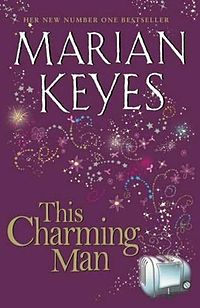
This Charming Man: Otherwise known as book #30!

Yes, it's true...I have reached book 30 for the year. Huzzah! In fact, it happened at the end of August which should tell you something about my blogging efforts (though I've been getting better - have you noticed?).

I picked up This Charming Man, by Marian Keyes, when I was in Italy. Even though this particular edition was enormous, I still couldn't resist - her books are generally light and fluffy but loveable. I have been carrying around a soft spot for Angels for years. This Charming Man centers around popular Irish politican Paddy de Courcy and the four women who have been most affected by him. The novel starts with Lola, completely crushed as she learns that Paddy is getting married - because she's his girlfriend but not the fiancee. It then turns to Grace, a journalist, and Marnie, her alcoholic sister, who knew Paddy as teenagers. Lastly is Alicia, Paddy's surprise fiancee, who has an odd role as a wallflower (and as it turns out later, a backstabber). Each woman has her own section in the book as we see their life and Paddy's effect, either past or present on that, until they come together as a group near the end.

This book was a little darker than the other Keyes' books I've read. To the world, Paddy is a JFK-like figure but it turns out that he's conniving, selfish and abusive, and has done some serious psychic damage to these ladies. There's a really delicate balance that has to be made between chick-lit lightness and topical seriousness but overall, I thought she did it well, and I ended up giving the book to my mom to read.

Wednesday, October 26, 2011

People of the Book: Good but sorta passionless (#29)

Geraldine Brooks' People of the Book has a lot of promise: Rare book expert Hanna Heath travels Sarajevo in 1996 to inspect and stabilize the refound Sarajavo Haggadah, an illuminated Jewish codex that miraculously survives the ravages of time. The book actually exists and from what I remember of the plot, Brooks pretty closely follows the real Haggadah's history as is known but inserts fictional characters and develops plausible vignettes around them. I found People of the Book to be interesting, certainly, but I wasn't captivated by it - and what I most want from my books is to be swept up. Partially I think I just don't connect with Brooks' writing style as I had the same reaction to Year of Wonders, a novel about a plague that wrecks havoc on a small English town.

As the title implies, People of the Book is about the people whose (imagined) lives were touched by the Haggadah. Hanna is only the last of them and her story - along with her unresolved love issues, both with her domineering mother and a librarian she meets - bookends the novel. Which is fine and dandy - except that I found Hanna to be an incredibly frustrating character. She's good at her job but a wallflower in all other aspects of her life and yet again, I had a difficult time empathizing. She eventually gets it together and owns her identity but hot damn if it didn't take the entire book. (I know, I know, it's character arc but does she have to start out so passive?)

As Hanna does her inspection on the Haggadah, she finds tiny items in the book - a moth wing, a white hair, a wine stain - which then launch the vignettes, as we see how each of these items made its way there. The individual stories were interesting but also disconnecting  because Hanna herself never and cannot discover such historical detail - and I found it strange that the reader takes a journey that the protagonist has no clue about. As much as I disliked Hanna, it was still her story and I thought it an odd choice to effectively dump the protagonist in sections along the way. (I also thought it was weird that the stories went backwards in time - I get it intellectually but on paper it felt like a dismantling rather than a building up to something.) It was again emotionally separating and so while I liked the book, I never found that I cared all that much. You knew from the outset that this precious book was safe (or ostensibly anyway - there ends up being a last-minute mystery) so the connection has to be through Hanna...and for me, it just wasn't there.

Photos of the Haggadah's gorgeous illuminations, including the one I used at the top, can be found here: http://www.haggadah.ba/?x=2&y=1#. It now lives in Sarajevo's National Museum of Bosnia and Herzegovina.